Pages

Tuesday, March 8, 2016

HFC S2016: Lecture 11+12: Enter the Etruscans

An exterior exposure of a Etruscan Tomb
Last week we discussed the City of Delos, and how it became a new idea for city organization. This week we continue on our historical look, but rather than just look at an organizational plan we are also interested in the effect a culture can have on its place.


Interior of an Etruscan tomb (a different location than pictured at start of post)

The Etruscans are probably most noteworthy for the inspiration of a progeny culture we know as the Romans. Combined with the perhaps more well known connection to the Greeks, Etruscans lived on the same lands (and for a time alongside the Romans) an occupied and began building permanent traces and manifestations of organized society - and culture. Not just Temples, or permanent military encampments, but also homes for cultural institutions, ideas about building methodology, and developing their own expression of style. Etruscans served as a precursor and a competitor that would eventually push the younger Roman culture to the forefront.

Ultimately history tells that Etruscan society was slowly adapted, enveloped and became a part of an ever expanding Roman Empire - but not before laying foundations which can still be read if you look closely. While reading the lecture, look to see if you find Etruscan influences, not just on the Romans (f.y.i. our next section of study) - has the Etruscan influence has reached even further?

Again, here is another suggested question (optional) you may consider while reading, to get the gears turning:

Are there elements in our urban environments that you might trace to an Etruscan influence?

Comments are due Monday Mar 14th

Monday, February 29, 2016

HFC F2016: Lectures 9 + 10 Delos; Part 2

Please note special directions regarding Lectures 9 + 10 which will be collected over the course of  two blog posts.

Please post your comments here for Lecture 9 first on the appropriate blog post, and the the comments for Lecture 10 here.

(Early comments earn give all students more traction for course participation, comments this Lecture are due on Friday, for Part II by Monday, see each post for specific details)

Study of Delos: Part 2

Question for Lecture 10
How do American cities resemble Hippodamus's?

(excerpted from Part 1)
...This question may at first seem as though it can be answered in a few short comparisons - but I challenge you to look deeper in the planning and the evolution of Delos in your comparisons!! Be explicit, use the language we have developed thus far through the semester and apply it to an american city of your choosing. Be diverse - if someone has already chosen a city move on to look at another - what can you tell by the shape, historical maps, and the way that it has grown and built over time?

Reference the planning, generation, extension or build out of a the history of a specific American city - why do you think this system was chosen?

Hint: (There are MANY potential candidates that have followed the the grid, or the axial road system)

Comments for Lecture 10 Part 2 are due by Monday March 7th

HFC S2016: Lectures 9 + 10 Delos; Part 1

Please note special directions regarding Lectures 9 + 10 which will be collected over the course of  two blog posts.

Please post your comments here for Lecture 9 first - see below.

(Early comments give all students more traction for course participation - and a chance to earn more points for participation!  Comments this Lecture are due on Friday, for Part II by Monday, see each post for specific details)

Study of Delos: Part 1
This series of double-loaded lectures detail the Greek city of Delos. (Here is a link to it's location in the Aegean Sea viewable on Google Maps) The first lecture describes the history and evolution of the city, in the second lecture we will start to examine in finer detail the effects of the planning and evolution of the city.

As you read both the lectures consider the question you will have to answer at the end of Lecture 10 - "How do American cities resemble Hippodamus's?"

This question may at first seem as though it can be answered in a few short comparisons - but I challenge you to look deeper in the planning and the evolution of Delos in your comparisons as well.

There are two very important premises to keep present in your mind during the unfolding of this course:

The city is a constantly changing, adapting, evolving expression of the people who live within it, their lives, their plans, it is functional, cultural, and built on the traces of the history of the spaces and places that together make what we know as "the city".

Philadelphia itself is an excellent living classroom/laboratory to explore and find examples of what we are reading about and talking about in the class.

The resources of the internet now mean that you can visit Delos virtually flying overhead via Google Earth or Google Maps; the latter also includes geo-tagged photos of the ruins - utilize the resources to get a better feel for the layout and scale of this ancient city.

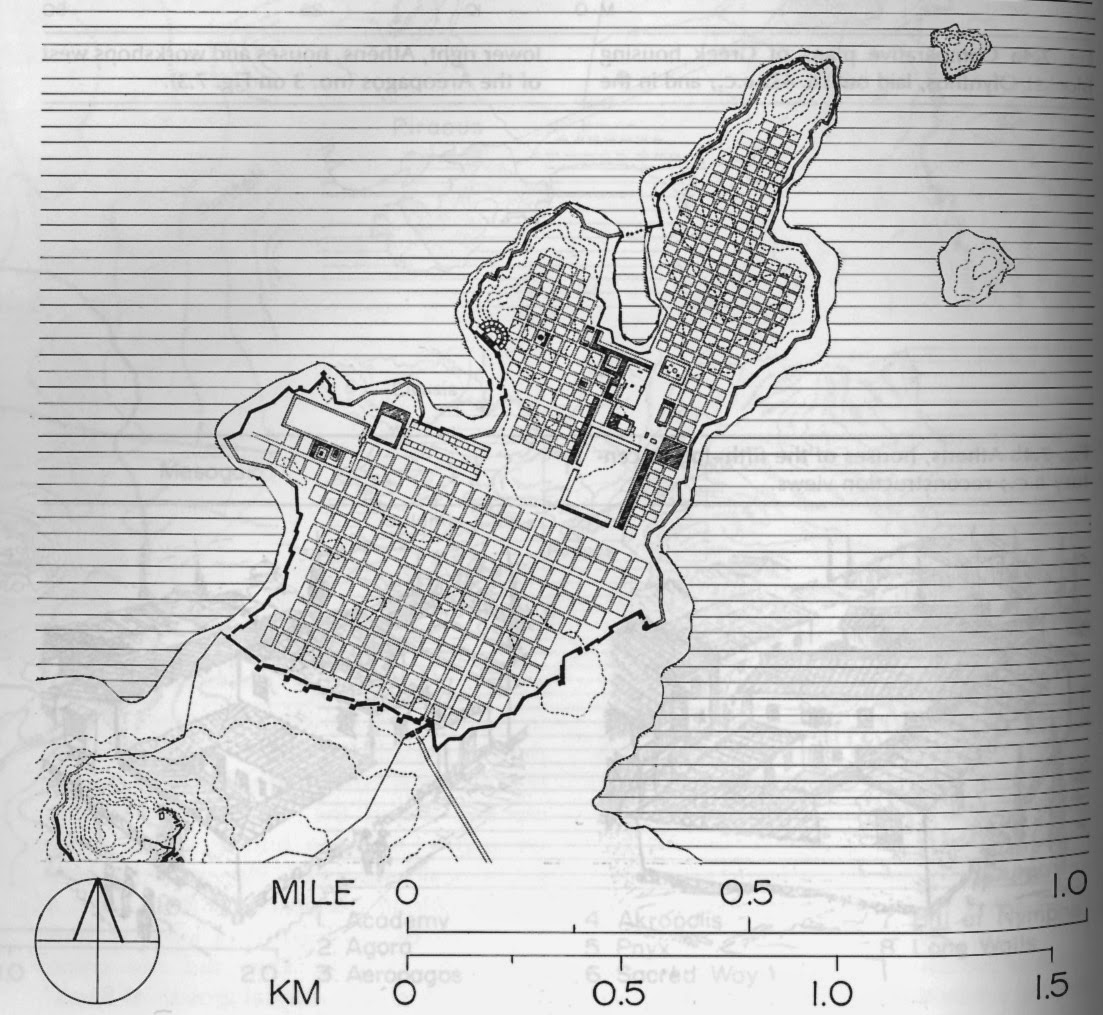
Illustration of Miletus, a city of ancient Greek origins located in modern day Turkey. Illustration thanks to online archive of Prof. of Geography, Dr. Richard Fusch, at Ohio Wesleyan University
Up until this point we have been studying the slow evolution of people gathering together in groups, and slowly collecting a language of building their civilization. From Delos onwards we will increasingly be looking not just at the continuing slow evolution of that same process, but what happens when a civilization takes charge of that process, and utilizes it for continued growth moving forward (economic, defensive, cultural, environmental, etc.) and further how those plans impact the form the city evolves into.

Questions for Lecture 9:
Give an example of an American City (better yet a specific area of that city) that follows Hippadamus's rationale; Where is this rationale most notable? What are the benefits of that rationale? How has that planning affected your perception of that space/place/neighborhood? Where is a space/place which departs from that rationale - why do you think that happened?


Comments for Lecture 9 are due by Friday March 4th

Monday, February 22, 2016

HFC S2016: Lectures 7 + 8

We will collect comments for Lectures 7 + 8 under this post.
This set of lectures are very brief, which allows us the freedom and time to begin to ponder it's linkage with the history of the city, as we have studied it thus far, and to begin the process, as we will in our lectures moving forward, of finding elements of the lectures in the city and built environment around us.
As you read keep in mind the words 'sacred' and 'profane' do not necessarily directly translate to churches and run down corners respectively. The meaning and use of those words have more depth. While a church is perhaps an immediate image of a sacred space, your living room, a community garden, or perhaps home plate at Citizens Bank Park might be representations of deeply rooted 'sacred' places. Additionally, a 'profane' space might not just be a tired old building, it could manifest as profusely public space, a decidedly un-sacred space, or simply primarily utilitarian space - a highway, a stair tower.
Citizen Bank Park in particular could be viewed both as a sacred space and a profane space, being both very public and consisting of a vast amount of 'profane' infrastructure - sculpted around a sacred space (the field). Or the entire park could be viewed as profane public, open, very utilitarian (a mere configuration of stairs, seats, restrooms) and the sacred could arguably be the game itself. The argument continues to change if you are a Phillies Phanatic, or a Mets fan, or not a fan of baseball at all.

A final example, as seen from afar the skyline of the city of Philadelphia could be seen as a 'sacred' construction - just look at the debates about height, vista, skyline which followed the building of Liberty One or the more recent Comcast Center, and now it's new twin. However when in Center City the view of the skyline (which can only be seen in its entirety from afar) breaks up, becoming an assemblage of smaller sacred and more vast profane spatial sequences.

This is just an example of how the idea of 'sacred' and 'profane' spaces are found throughout the spaces we live and interact.

Required Questions for Lecture 8:

1) Give an example of a sacred and a profane space you move through in the city regularly and explain why you chose them.

2) Choose a few of the elements which you find particularly important that make these spaces either sacred or profane and analyze them (are they elements of the space? people in the space? an idea or ideal it exemplifies?) What are they and how do they reinforce your choice?

Weekend Peer Rebuttals
Now that we are further into the semester we have developed the basis of a shared language of space, urbanism and design when looking at cities.
Rebuttals: After posting your answer read (or return to read) your peer's comments, post them questions, inquiries, responses which engage their points, compare or contrast against your own and challenge them to do the same. Revisit the site over the weekend to post rebuttal responses.

Extra Food for Thought:
HINT: Have you missed an assignment? Looking to make up for lost class participation? be sure and post a separate answer to on of the 'Food for Thought' and take advantage of this opportunity to add to the discussion.
A) Can you think of any spaces which are perhaps both sacred and profane, based on your understanding?
B) Challenge one of your classmates choices of sacred or profane space - can you (as in the ball park above) find the profane in the sacred - or vice versa?

Comments For Lecture 7 + 8 are due posted by Friday, February 26th, 
Food For Thought + Rebuttals to Peer questions are due by Monday February 29th

Tuesday, February 9, 2016

HFC S2016: Lecture 6 Spatial Critique

Please respond to the following questions for this week's lecture under the blog comments:

1) Pick a space within the city and describe how it functions in terms of the types of space listed in the lecture. Describe the space and its functions in detail, be specific. Most spaces are made up a collection of the elements of the types of space - identify the primary 'type' of space that the city space you choose is, identify the characteristics that signify that it is this spatial 'type' and explain how they function.

2) Most spaces within the city interact with adjacent spaces and spatial types within the city, explain how the space you chose interacts with, affects, and is affected by an adjoining urban space.

3a) If you were in Philadelphia this weekend during the Papal Visit: Describe using the vocabulary of the lecture describe a space and the qualities of spatial relationships which the event utilized. Be specific.

3b) If you were not in Philadelphia this weekend during the visit: Describe a large outdoor civic event you were present for, using the vocabulary of the lecture describe the space and qualities of spatial relationships utilized by the event. Be specific.

Comments for this week's posts are due by Friday, February 12th, by 10 PM EST

If you are encountering any issues posting comments please notify Prof Hart immediately.

HINT: To protect, refine and improve your written work it is recommended that you draft, proofread and edit your responses in a save word document before copy-and-pasting the text into the comments bar of the webpage - composing your comments only in the comments bar makes clear writing, editing and saving not just difficult but if you hit the wrong button impossible!!